Marketing Strategy vs GTM Strategy: What Sets Them Apart
Understanding the difference between marketing strategy vs GTM strategy is essential for building a strong and scalable business. While both concepts are closely related, they serve different purposes and operate at different stages of business growth. Knowing how to use them together can significantly improve your chances of success.
This guide explains each concept clearly, highlights the key differences, and shows how they work together.
What Is a Marketing Strategy
A marketing strategy is a long-term plan that defines how a business will attract, engage, and retain customers. It focuses on building brand awareness, positioning, and sustained growth over time.
This strategy answers fundamental questions about your target audience, value proposition, and communication channels. It includes elements such as content marketing, SEO, social media, branding, and customer experience.
A well-defined marketing strategy ensures consistency in messaging and helps businesses stay competitive in the market. It is ongoing and evolves based on market trends and customer behavior.
What Is a GTM Strategy
A go-to-market strategy, often called GTM strategy, is a focused plan for launching a product or service into the market. It outlines how a company will reach its target customers and achieve initial traction.
Unlike a marketing strategy, a GTM strategy is short-term and action-driven. It includes specific steps such as identifying target segments, choosing distribution channels, setting pricing, and planning sales tactics.
GTM strategies are especially important for new product launches, entering new markets, or rebranding efforts. They help ensure that the right message reaches the right audience at the right time.
Key Differences Between Marketing Strategy and GTM Strategy
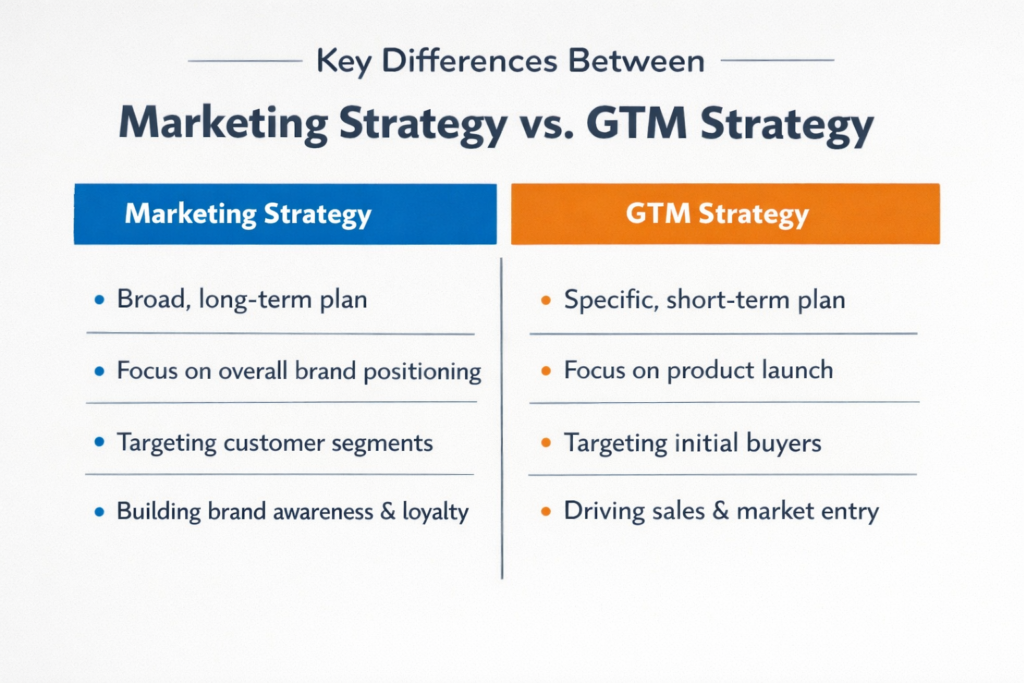
The main difference between marketing strategy vs GTM strategy lies in scope and timing. A marketing strategy is broad and long-term, while a GTM strategy is narrow and focused on execution.
Marketing strategy centers on brand building and customer relationships. In contrast, GTM strategy focuses on product launches and market entry.
Another difference is duration. Marketing strategies run continuously, whereas GTM strategies are temporary and tied to specific campaigns or launches.
Marketing strategy also covers multiple channels and touchpoints over time. GTM strategy, however, selects specific channels that will deliver quick results during a launch phase.
Finally, marketing strategy shapes overall direction, while GTM strategy acts as a tactical roadmap to achieve short-term goals.
How Marketing Strategy and GTM Strategy Work Together
Although they are different, marketing strategy and GTM strategy are deeply connected. A strong marketing strategy provides the foundation for an effective GTM plan.
For example, your brand positioning and audience insights from the marketing strategy directly influence your GTM decisions. This ensures consistency and improves the effectiveness of your launch.
At the same time, GTM strategies provide valuable feedback. The results from a launch can help refine your broader marketing strategy and improve future campaigns.
When both strategies align, businesses can achieve faster growth and better customer engagement.
When to Use a Marketing Strategy
A marketing strategy should be used when you want to build long-term brand value and maintain a steady flow of customers. It is essential for ongoing business operations and growth.
Businesses should continuously update their marketing strategy to adapt to changing trends, customer preferences, and competitive landscapes.
When to Use a GTM Strategy
A GTM strategy is most useful when launching a new product, entering a new market, or targeting a new audience segment. It helps create focus and ensures efficient use of resources.
Companies often use GTM strategies during critical business moments when timing and execution are crucial.
Common Mistakes to Avoid
One common mistake is treating both strategies as the same. This can lead to confusion and ineffective planning.
Another issue is skipping a GTM strategy during a product launch. Without a clear plan, even a strong marketing strategy may fail to deliver results.
Businesses also make the mistake of not aligning both strategies. Lack of alignment can result in inconsistent messaging and missed opportunities.
FAQs
What is the main difference between marketing strategy and GTM strategy
The main difference is that marketing strategy focuses on long-term growth, while GTM strategy focuses on short-term product launches and market entry.
Is GTM strategy part of marketing strategy
Yes, a GTM strategy can be considered a subset of a broader marketing strategy, as it focuses on specific execution plans.
Do small businesses need both strategies
Yes, small businesses benefit from both. Marketing strategy ensures consistent growth, while GTM strategy helps with successful launches.
Can a business succeed without a GTM strategy
It is possible, but unlikely. A GTM strategy increases the chances of a successful launch by providing clear direction.
How often should a marketing strategy be updated
A marketing strategy should be reviewed regularly and updated based on market trends and performance data.
Conclusion
The difference between marketing strategy vs GTM strategy comes down to scope, timing, and purpose. Marketing strategy builds the foundation for long-term success, while GTM strategy drives focused action during key business moments.
By using both strategies together, businesses can create a balanced approach that supports growth, improves launches, and delivers better results over time.