

EU AI Act News Overview
The EU AI Act is one of the world’s first comprehensive regulations focused on artificial intelligence. It aims to create a legal framework that ensures safe, transparent, and ethical AI systems.
Recent EU AI Act news highlights rapid developments in policy enforcement and global influence. Governments and companies are closely monitoring these updates.
What Is the EU AI Act
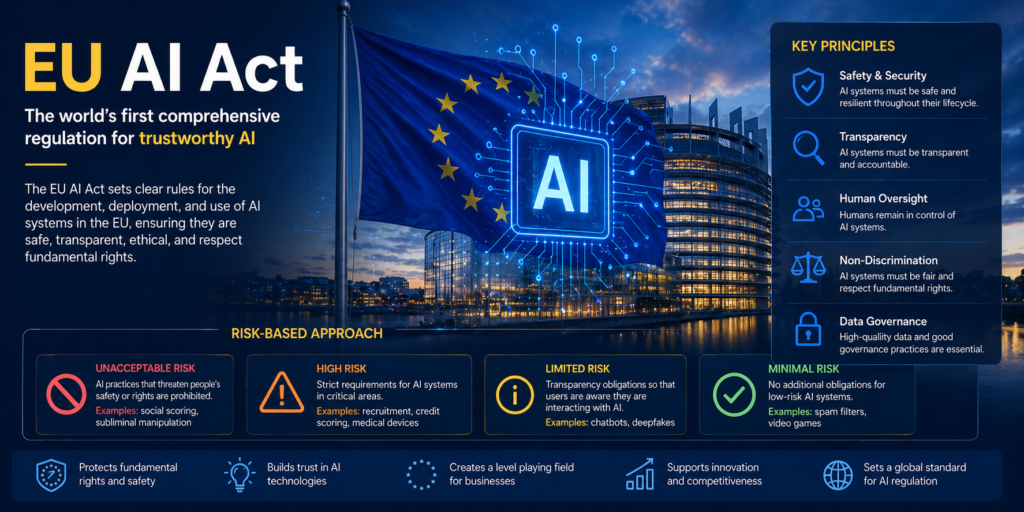
The EU AI Act is a legislative proposal designed to regulate AI technologies based on risk levels. It categorizes AI systems into unacceptable, high, limited, and minimal risk.
This structured approach helps control harmful AI use while encouraging innovation. It also sets clear compliance requirements for developers and organizations.
Latest EU AI Act News and Updates
Implementation Timeline
Recent updates indicate phased implementation across EU member states. Companies are being given time to adapt to compliance requirements.
Deadlines vary depending on the risk category of AI systems. High-risk systems face stricter and faster enforcement.
Focus on High-Risk AI Systems
High-risk AI applications, such as those used in healthcare and finance, are under strict regulation. These systems must meet transparency, safety, and accountability standards.
This ensures user protection and reduces potential harm. It also increases trust in AI technologies.
Global Impact and Influence
The EU AI Act is influencing AI regulations worldwide. Countries outside the EU are considering similar frameworks.
This positions the European Union as a global leader in AI governance. It may shape international AI policies in the coming years.
Key Features of the EU AI Act
Risk-Based Classification
AI systems are categorized based on potential risk. This allows tailored regulations for different use cases.
It ensures stricter rules for sensitive applications while keeping low-risk innovation flexible.
Transparency Requirements
Developers must disclose how AI systems operate. Users should be aware when interacting with AI.
This improves accountability and user trust. It also reduces misuse of AI technologies.
Compliance and Penalties
Non-compliance can result in significant fines. Companies must align their systems with EU standards.
This encourages responsible AI development and deployment.
Benefits of the EU AI Act
The EU AI Act promotes ethical AI usage and protects user rights. It creates a safer digital environment for individuals and businesses.
It also provides clear guidelines for companies, reducing uncertainty. This helps organizations innovate within a defined framework.
Challenges and Concerns
Some companies are concerned about compliance costs and complexity. Smaller businesses may face challenges adapting to strict regulations.
There are also debates about balancing innovation and regulation. Overregulation could slow technological growth if not managed carefully.
Who Is Affected by the EU AI Act
The regulation affects AI developers, tech companies, startups, and organizations using AI systems. It also impacts global businesses operating in the EU market.
Even non-EU companies must comply if they offer AI services within the EU.
SEO Insights for EU AI Act Content
Content optimized around EU AI Act news should include semantic keywords like AI regulation, artificial intelligence law, and compliance framework.
Using structured headings and concise paragraphs improves readability and ranking. This aligns with modern SEO best practices.
FAQs
What is the EU AI Act
The EU AI Act is a regulation that governs the development and use of artificial intelligence systems in the European Union.
When will the EU AI Act take effect
Implementation is phased, with different timelines depending on the risk level of AI systems.
What are high-risk AI systems
High-risk AI systems include applications in healthcare, finance, and critical infrastructure that require strict compliance.
How does the EU AI Act affect companies
Companies must ensure their AI systems meet transparency, safety, and compliance standards or face penalties.
Why is the EU AI Act important
It sets global standards for ethical AI use and ensures user safety and trust in AI technologies.
Conclusion
EU AI Act news continues to shape the future of artificial intelligence regulation. Its risk-based approach provides a balanced framework for innovation and safety.
As implementation progresses, businesses must stay informed and adapt quickly. Understanding these updates is essential for long-term success in the AI industry.
