Understanding Claude Rate Exceeded Error
The claude rate exceeded error is a common issue developers face when using AI APIs. It happens when the number of requests exceeds the allowed limit set by the service provider. Therefore, understanding this error is crucial for maintaining smooth application performance.
Moreover, rate limits are essential because they prevent system overload. They ensure fair usage across users and protect infrastructure stability. However, when not managed properly, they can disrupt workflows and degrade user experience.
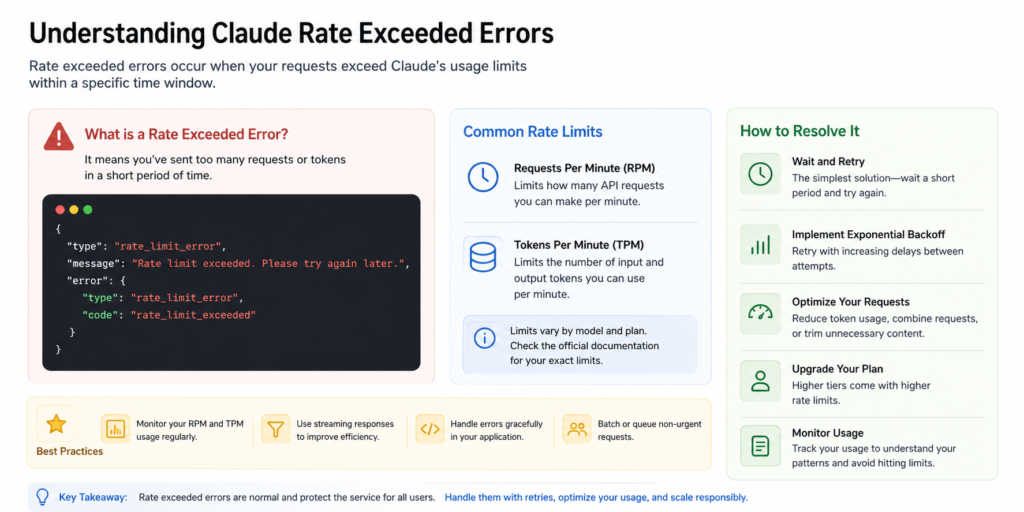
What Causes the Error
This error usually occurs when too many API requests are sent within a short period. Additionally, inefficient code or loops can unintentionally trigger excessive calls. As a result, the system temporarily blocks further requests.
How API Rate Limits Work
API rate limits define how many requests you can send per minute or second. Typically, providers assign limits based on subscription tiers. Consequently, exceeding these thresholds triggers the claude rate exceeded error.
Common Scenarios Where the Error Occurs
Understanding where this issue appears helps you fix it faster. In most cases, developers encounter it during scaling or testing phases.
API Overuse
When applications send repeated requests without optimization, limits are quickly exceeded. Moreover, frequent polling can amplify the problem.
High Traffic Applications
Apps with many users generate simultaneous API calls. Therefore, without proper load balancing, rate limits are reached rapidly.
Misconfigured Requests
Incorrect configurations, such as unnecessary retries or duplicate calls, also cause the claude rate exceeded error. Additionally, poor request structuring increases API consumption.
How to Fix Claude Rate Exceeded Error
Fixing the claude rate exceeded error requires both technical adjustments and strategic planning. Below are proven solutions that work effectively.
Optimize API Calls
Reducing the number of API calls is the most direct solution. Moreover, efficient coding practices can significantly lower request frequency.
Reduce Frequency
Avoid sending requests too often. Instead, consolidate operations where possible.
Batch Requests
Batching allows multiple operations in a single request. Therefore, it reduces overall API usage and prevents hitting limits.
Implement Retry Logic
Retry mechanisms help manage temporary failures. However, they must be implemented correctly to avoid worsening the issue.
Exponential Backoff Strategy
This method increases the delay between retries gradually. As a result, it minimizes repeated rapid requests and stabilizes performance.
Upgrade API Plan
Sometimes, your application simply needs higher limits. Therefore, upgrading your plan can eliminate the claude rate exceeded error entirely.
Monitor Usage Metrics
Tracking API usage helps identify patterns. Additionally, it allows proactive adjustments before limits are exceeded.
Best Practices to Prevent Rate Limit Errors
Prevention is always better than fixing errors after they occur. Following best practices ensures long-term stability.
Use Caching Mechanisms
Caching stores frequently requested data. Consequently, it reduces the need for repeated API calls.
Efficient Token Usage
Optimize prompts and responses to minimize token consumption. Moreover, shorter requests often result in fewer API calls.
Error Handling Strategies
Proper error handling ensures graceful degradation. Therefore, users experience fewer disruptions even when limits are reached.
Tools for Monitoring API Usage
Monitoring tools play a critical role in managing API performance. They provide insights that help prevent the claude rate exceeded error.
Built-in Dashboards
Most API providers offer dashboards to track usage. Additionally, they display request counts and limit thresholds.
Third-Party Monitoring Tools
Tools like Prometheus or Datadog provide advanced analytics. Therefore, they enable real-time tracking and alerting.
Real-World Example and Case Study
Practical examples make it easier to understand how to fix this issue effectively.
Before Optimization
A SaaS platform experienced frequent claude rate exceeded error issues due to excessive API polling. Consequently, users faced delays and interruptions.
After Optimization
After implementing caching and batching, API calls dropped by 60%. Therefore, the platform eliminated rate limit errors and improved performance.
FAQs
What is the claude rate exceeded error?
It occurs when your application sends more API requests than allowed within a specific timeframe.
How can I fix the claude rate exceeded error quickly?
You can reduce request frequency, implement retry logic, and optimize API calls.
Does upgrading the plan remove rate limits?
No, but it increases the allowed request threshold significantly.
Why does this error happen during high traffic?
High traffic generates multiple simultaneous requests, which can exceed limits quickly.
Can caching help prevent rate limit errors?
Yes, caching reduces repeated API calls and minimizes usage.
What is exponential backoff?
It is a retry strategy that increases wait time between retries to avoid overwhelming the API.
Conclusion
The claude rate exceeded error can disrupt applications, but it is manageable with the right approach. By optimizing API usage, implementing retry strategies, and monitoring performance, you can prevent this issue effectively.
Moreover, adopting best practices ensures long-term stability and scalability. Therefore, start applying these strategies today to improve your system performance and eliminate rate limit errors.
Take action now by auditing your API usage and implementing the fixes discussed above.